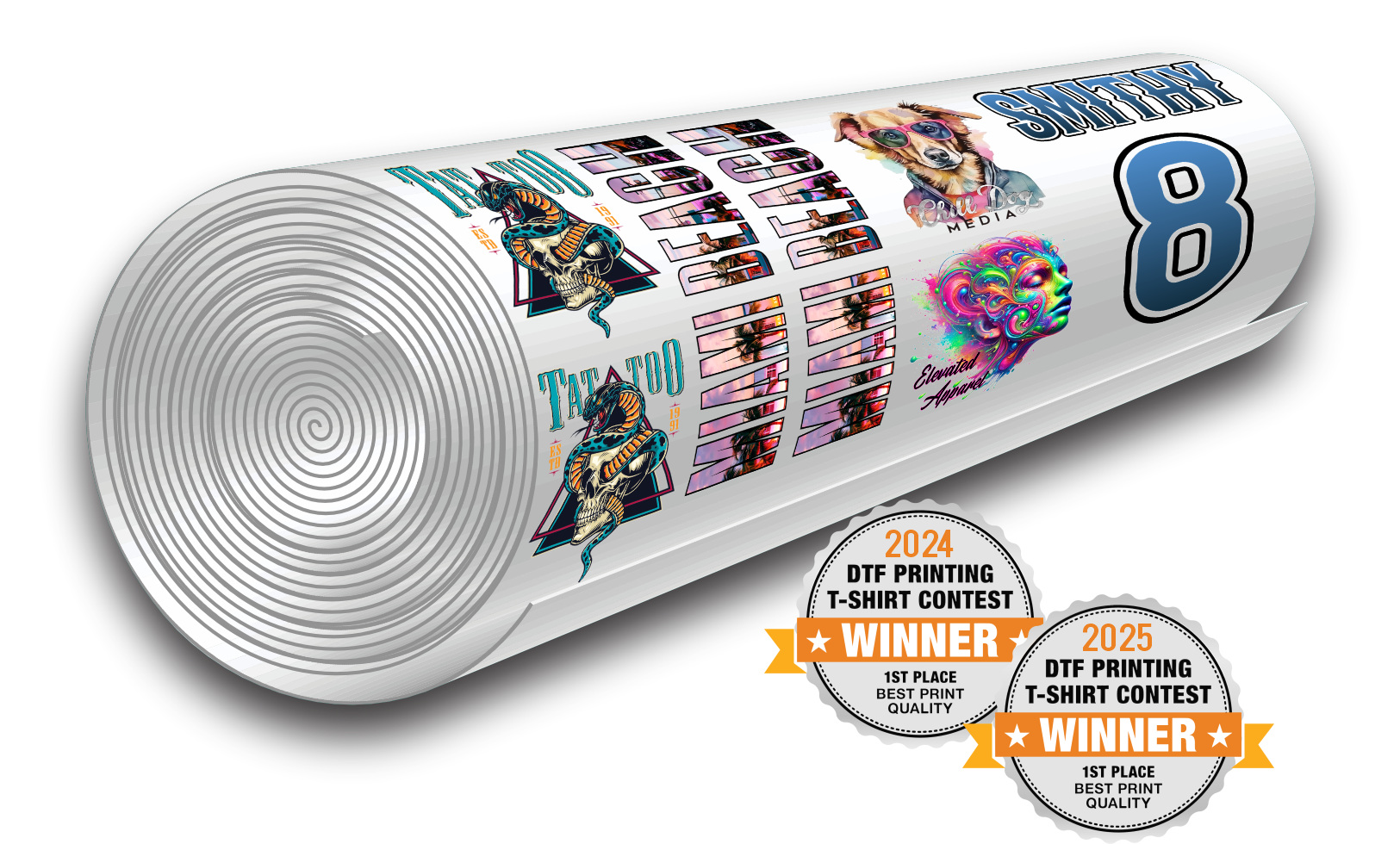
DTF gang sheets are custom-printed transfer sheets featuring multiple designs arranged together on a single roll of film—up to 22 inches wide and anywhere from 2 to 20 feet long. By grouping logos, sleeve graphics, and full-size artwork into one job (a process called “ganging”), you cut file prep time, reduce wasted film, and lower production costs—all while delivering prints that stay vibrant and durable through 60+ washes.
Every print shop, apparel brand, and DIY creator wants the same thing: produce more while spending less. DTF gang sheets are one of the simplest ways to boost productivity without giving up print quality.
Here’s the thing—whether you’re filling a single custom order or pressing hundreds of t-shirts, grouping artwork onto one sheet saves time, materials, and money. The difference between a chaotic production day and a smooth one often comes down to how well you plan your sheets.
In this post, we’ll walk through why efficiency matters in DTF printing, how gang sheets save time and reduce waste, the common mistakes that slow people down, and the best pro tips for streamlining your workflow. By the end, you’ll have a practical roadmap for getting more out of every sheet.
Why Does Efficiency Matter So Much in Direct To Film Printing?
Direct-to-film printing has exploded in popularity—and for good reason. It works on cotton, polyester, blends, canvas, and denim without requiring pretreatment of the garment before application. It delivers vibrant colors and doesn’t need the costly setup that screen printing demands. But popularity brings pressure—customers now expect fast turnaround and flawless results every time.
Why Does Growing Demand Require Smarter Production?
Customers want quick delivery and consistent quality, plain and simple. Small businesses especially feel this squeeze. Most can’t afford multiple DTF printers just to keep up with orders, so they need scalable solutions that stretch their existing equipment further.
Efficient workflows directly improve both profitability and customer satisfaction. When you can turn around an order faster, you take on more work and keep clients coming back. If you’re new to the technology, this beginner’s guide to DTF printing from Printful breaks down the basics of how the process works.
Why Does Every Minute and Every Inch of Film Count?
Material costs add up fast in this business. A roll of premium film isn’t cheap, and every empty space on a sheet is money left on the table. DTF printing charges by the sheet or linear foot rather than by the individual image—which means smart layout planning directly controls your costs.
Gang sheets can incorporate various sizes of designs onto one roll to maximize space. By thinking ahead about how designs fit together, you maximize your film usage instead of running half-empty sheets through the printer.
How Do I Keep Production Moving?
A solid system makes all the difference. Organize all artwork before uploading any files to save backtracking later. Prepare designs ahead of shipping deadlines so nothing gets rushed. For repeat clients, standardize your print sizes—that consistency speeds up everything from layout to pressing.
How Do DTF Gang Sheets Save Time?
This is where gang sheets really earn their keep. Instead of treating every design as a separate job, you batch them together intelligently.
What Exactly Is a DTF Gang Sheet?
A DTF gang sheet is a custom-printed transfer sheet that features multiple designs arranged together on a single film roll. “Ganging” is the process of grouping multiple artworks onto one sheet—designers organize their graphics into one large, high-resolution file (typically in PNG format) that fills the entire printable area. The sheet is then printed on a DTF printer, which first lays down color ink and then applies white ink underneath to create a bright, opaque base. This is what makes commercial-grade CMYK+W ink so effective—high-opacity inks deliver rich, accurate color on any fabric color, producing commercial-ready results every time.
Can You Print Multiple Customer Orders on a Single Sheet?
Absolutely—that’s the whole point. On one gang sheet, you can combine logos, left chest prints, sleeve graphics, and full-size artwork all at once. Gang sheets allow shops to print multiple customer orders in a single run, which simplifies production scheduling dramatically.
Think about it: rather than queuing ten individual files, you queue one well-organized sheet. The team at Heat Press Nation offers a helpful overview of DTF gang sheets if you want to see how others structure their layouts.
How Does File Preparation Get Faster?
Uploading one gang sheet beats uploading multiple individual files every time. You can upload files in PNG, PDF, or AI format, and files should be 300 DPI for best quality. With a good builder tool, you drag and arrange artwork efficiently, fitting pieces together like a puzzle. Getting your file setup right from the start eliminates the need for last-minute conversions or revisions.
What Roll Lengths Are Available?
Roll length is flexible—you can select from 2 to 20 feet, and sheets can be printed up to 22 inches wide. This gives you full control over how much film you use per job, whether you’re running a handful of custom designs or hundreds of transfers for a large event order.
How Can You Speed Up Heat Press Production?
Once your transfers arrive, consistency is king. Press multiple transfers using the same settings throughout the day to avoid constant readjusting. Since DTF transfers are true hot peel, you can remove the film immediately after pressing while it’s still hot—keeping your production line moving fast.
For a clean, professional finish, apply parchment paper or a Teflon sheet when needed. If you’re still dialing in your settings, this heat press temperature guide from Coastal Business Supplies is a solid reference.
Does Gang Sheet Printing Improve Order Management?
Yes—and this benefit is underrated. You can print several customer orders simultaneously, organizing them by project or product line. That organization slashes setup time between jobs and keeps your whole operation flowing. Less downtime means more pressed transfers—and more profit.
Photo by Compagnons on Unsplash
How Do Gang Sheets Reduce Waste?
Cutting waste is just as valuable as saving time. Wasted film and reprints eat directly into your margins.
How Do You Maximize Every Inch of Film?
The trick is fitting multiple designs together instead of leaving empty gaps. Since gang sheets can incorporate various sizes of designs onto one roll, tight and smart layouts improve material utilization and lower production costs. Treat each sheet like real estate—every square inch should be working for you.
DTF printing allows a high yield of varied designs at a lower cost compared to running individual jobs. With pricing as low as $0.02 per square inch, and bulk discounts that can save up to 62%, the math strongly favors smart gang sheet planning. For reference, a standard DTF gang sheet is priced at $19.99, while some competitors like Jiffy charge $25.00 for just a 2-foot gang sheet—a significant difference as your order volume grows.
How Do You Eliminate Unnecessary Reprints?
Reprints are the silent profit killer. Before uploading anything, double-check your artwork carefully. Verify that designs are at least 300 DPI, have a transparent background where required, and are free of watermarks. A two-minute check beats wasting a whole transfer. TheAdobe guide to exporting transparent PNGs is useful if you’re unsure about file prep.
Does Gang Sheet Printing Help With Inventory Management?
It does. You print exactly what you need—no more and no less. With no minimum order quantity required, you get real flexibility. You’re not forced to overproduce just to hit a threshold, which is a huge advantage for seasonal products where demand shifts quickly and excess inventory becomes dead weight.
Can You Save Money Without Sacrificing Quality?
This is the balance everyone chases, and gang sheets deliver it. Commercial-grade CMYK+W ink produces vibrant, color-accurate prints on every job. DTF prints are engineered for a soft hand-feel and durability—they resist cracking and peeling over time, hold up through 60+ washes without fading, and are certified for over 100 washes. Customers consistently report vibrant colors and excellent print quality, and that soft hand-feel keeps them coming back for repeat orders.
What Are the Most Common Efficiency Mistakes?
Learning to avoid these common pitfalls saves time, material, and frustration.
Why Is Uploading Low-Quality Artwork a Problem?
Low-resolution images directly hurt print quality—they come out blurry or pixelated. Always prepare your files at 300 DPI before submitting. Watermarked images are even worse; they’re simply unusable. Verify your artwork before uploading—it’s the easiest mistake to prevent.
What Happens If You Ignore Proper File Setup?
Using the wrong file format (instead of PNG, PDF, or AI) can slow production while you scramble to convert. Poor spacing wastes valuable sheet space you’ve already paid for. Inconsistent sizing creates unnecessary revisions that push back deadlines. Get the setup right the first time—it pays off immediately.
Why Does Fabric Compatibility Matter?
DTF transfers work beautifully on cotton, polyester, blends, canvas, and denim without requiring any pretreatment of the garment. That said, nylon fabrics are not recommended for DTF transfers, so always confirm your material before committing to a large production run. The American Apparel fabric guide helps when you’re matching transfers to unfamiliar garments.
How Do Heat Press Settings Affect Your Results?
Incorrect temperature or pressure ruins durability—your prints will crack or peel early. Hot peel transfers require you to remove the film immediately after pressing while it’s still hot, which speeds up production. Always follow your supplier’s specific instructions. Consistent pressing creates better, longer-lasting results that build customer trust.
What Are the Best Pro Tips for Streamlining Production?
After plenty of trial and error, these four habits keep a shop running smoothly.
Should You Build Standardized Gang Sheet Templates?
Definitely. Save your frequently used layouts as templates to speed up repeat orders enormously. Templates also help maintain consistent branding across every job—no guessing about placement or sizing.
Why Should You Batch Similar Orders Together?
Grouping t-shirts with matching colors or sizes reduces downtime between press cycles. When you’re not constantly changing settings or swapping garments, your workflow stays tight and efficient. Batching is one of the simplest wins available.
What Makes a Good Design Tool?
User-friendly tools matter more than people think. Drag-and-drop gang sheet builders simplify the entire setup process and support the right file formats—PNG, PDF, and AI—so you’re not stuck converting files before you even start. The ability to preview artwork before purchase helps catch errors early, before they cost anything. For more on print design basics, Canva’s design school offers free tutorials worth bookmarking.
Why Should You Partner With a Reliable Transfer Supplier?
Your supplier can make or break your efficiency. Look for award-winning print quality that delivers dependable results every time. Fast shipping—typically within 24 hours—helps you meet tight deadlines without panic. No minimum order quantity means you can run small test batches or large production runs with equal ease. And a one-stop shop offering transfers, heat presses, and supplies together simplifies your ordering so you’re not juggling five vendors.
This is exactly why shops rely on Limitless Transfers. As back-to-back first-place award winners for DTF quality in 2024 and 2025, they ship same day on orders placed by noon EST, offer free UPS Ground shipping on orders over $50, and require no minimums. Their gang sheet builder makes layout simple even without design software—and their CMYK+W printing delivers the vibrant colors, soft hand-feel, and 100+ wash certification that keeps customers coming back.
Work Smarter With DTF Gang Sheets
DTF gang sheets help you produce more in less time while reducing waste and maintaining exceptional print quality. That’s the trifecta every print operation chases.
Efficient production isn’t only about speed, though. It’s about maximizing every sheet, every project, and every opportunity that comes your way. When you treat your film like the valuable resource it is—at as low as $0.02 per square inch with bulk savings of up to 62%—the results add up fast.
Whether you run a small business or a large-scale apparel operation, custom DTF gang sheets deserve a permanent spot in your workflow. With vibrant, durable prints certified for 100+ washes, effortless application on cotton, polyester, blends, canvas, and denim, and fast fulfillment within 24 hours, there’s no reason to leave efficiency on the table. Plan smarter, press faster, and watch your margins grow.
Frequently Asked Questions
What exactly is a DTF gang sheet?
A DTF gang sheet is a custom-printed transfer sheet that features multiple designs arranged together on a single roll of printable film. Ganging—the process of grouping multiple artworks onto one sheet—lets you combine logos, graphics, and full prints into one job to save film, time, and money. You can select roll lengths from 2 to 20 feet, and sheets print up to 22 inches wide.
How much money can gang sheets actually save me?
Quite a bit. DTF gang sheets cost as low as $0.02 per square inch, and bulk discounts can save up to 62% compared to smaller orders. A standard gang sheet is priced at $19.99, while some competitors charge $25.00 for just a 2-foot sheet. Since printers charge by the sheet or linear foot—not by the individual image—filling every inch of your sheet is the key to keeping costs low.
Do DTF transfers work on all fabric types?
DTF transfers work on cotton, polyester, blends, canvas, and denim—and no pretreatment is needed before applying them. However, nylon fabrics are not recommended for DTF transfers. For specialty or unfamiliar materials, always test a sample before a large production run.
Are gang sheets a good fit for small businesses and hobbyists?
Yes. Gang sheets are ideal for small operations because no minimum order quantity is required—you print exactly what you need. You get professional results without committing to large wholesale quantities or investing in expensive in-house equipment. The result is commercial-quality prints at a fraction of the cost.
What’s the difference between hot peel and cold peel transfers?
Hot peel transfers let you remove the film immediately after pressing while it’s still hot, which speeds up production significantly. Cold peel transfers require the film to cool first. Most high-quality DTF transfers—including those from Limitless Transfers—are true hot peel. Always follow your supplier’s specific instructions for the best results.
How long do DTF transfers actually last?
DTF prints are built for durability. They resist cracking and peeling over time, withstand 60+ washes without fading, and are certified for over 100 washes. High-opacity CMYK+W inks ensure commercial-ready results that hold up in real-world use—which is why customers consistently report vibrant colors and excellent print quality even after repeated washing.
How do I avoid reprints when using gang sheets?
Double-check every design before uploading. Confirm your images are at least 300 DPI, free of watermarks, saved in PNG, PDF, or AI format, and have a transparent background where needed. A quick review before printing prevents most reprints and protects your margins.