
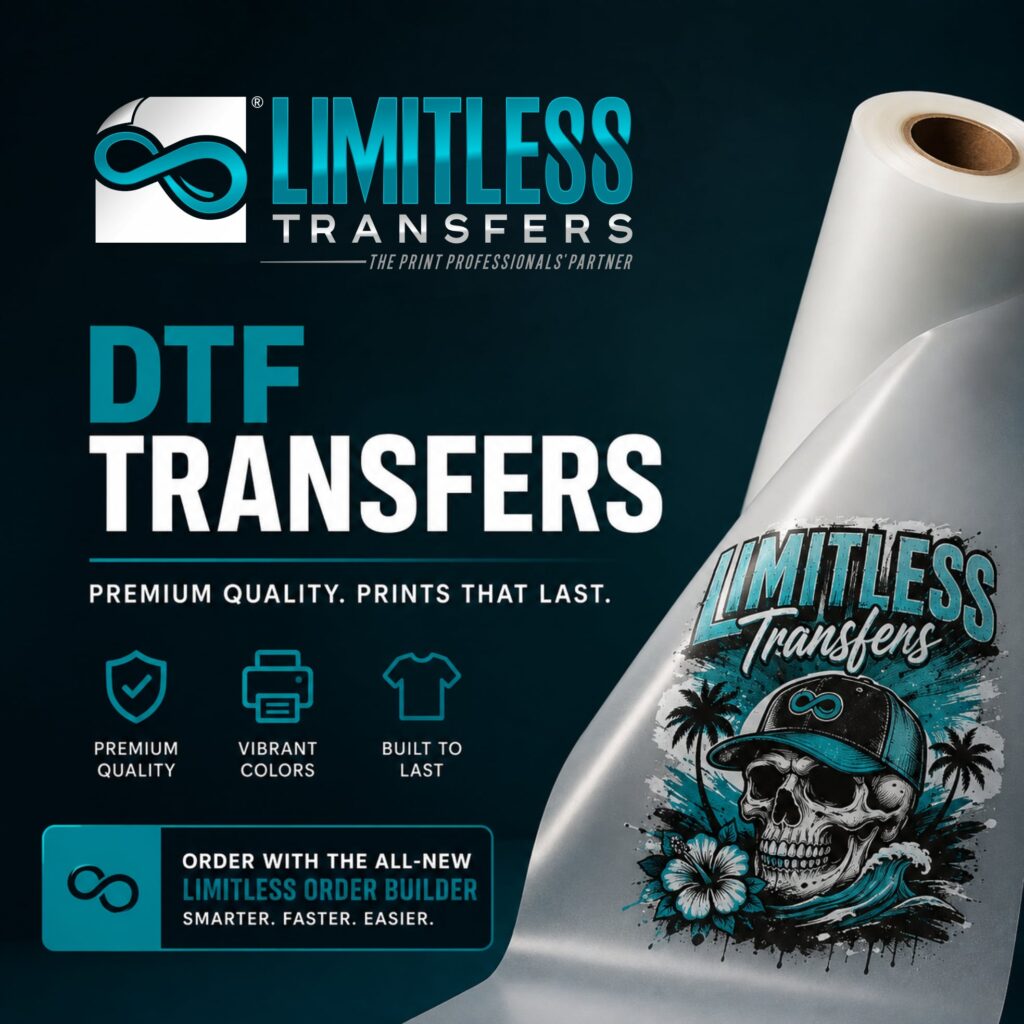
DTF stands for Direct-to-Film printing. A DTF transfer is a design printed onto PET film with CMYK inks, a white ink layer, and hot-melt adhesive powder, then heat pressed onto a garment. Most apparel businesses order ready-to-press DTF transfers instead of buying a printer, avoiding equipment costs while still getting vibrant, durable prints on nearly any fabric.
If you’ve been browsing custom apparel forums or scrolling through Etsy shop setups, you’ve probably run into the term DTF. It gets thrown around a lot, often without much explanation, which leaves a lot of people wondering what a DTF transfer is, and whether they need to buy an expensive printer to use the technology.
The short answer: no. DTF stands for Direct-to-Film printing, and it’s become one of the most popular printing methods in custom apparel because it produces vibrant, durable designs on almost any fabric without the setup costs of screen printing or the fabric restrictions of sublimation printing. Many people assume they need to own a DTF printer to take advantage of this technology. In reality, most small businesses, Etsy sellers, and print shops simply order professionally printed transfers and apply them with a heat press.
Throughout this guide, I’ll walk through how DTF printing works, what equipment you actually need (and don’t), and why I recommend ready-to-press transfers for most apparel businesses rather than investing in your own DTF printer.
What Does DTF Stand For?
DTF Means Direct-to-Film Printing
DTF stands for Direct-to-Film printing, a digital printing process where a design is printed onto a special PET transfer film rather than directly onto a garment according to Wikipedia. That film then carries the design through a few more steps before it’s ready to be pressed onto apparel.
PET transfer film is a thin polyester film designed specifically to hold ink and adhesive in place until it’s transferred to fabric. Despite some product pages listing film thickness at around 0.75mm, most industry guides place standard DTF PET film in the 75 to 100 micron range (roughly 0.075–0.1mm), with 75 micron film being the common choice for general-use transfers. This thinner film is part of what makes DTF transfers flexible and soft to the touch once pressed.
This process is what produces the vibrant color and crisp detail DTF is known for. Because the design is built up in layers on film first, rather than soaking directly into the fabric fibers, DTF transfers hold their color and sharpness across a wide range of materials. For a broader look at how color reproduction works in printing generally, the National Institute of Standards and Technology publishes resources on color and measurement standards.
What Is a DTF Transfer?
A DTF transfer is a professionally printed, ready-to-press design. Unlike a blank sheet of transfer paper you’d print yourself, a DTF transfer already contains everything needed to bond to fabric:
- CMYK ink layers that form the full-color design
- A white ink layer printed beneath the design, which allows the colors to show up accurately on both light and dark garments
- A hot-melt adhesive powder layer that bonds the design to fabric under heat and pressure
Because the transfer arrives finished, customers don’t need to own a printer, RIP software, or a curing oven. They simply purchase ready-to-press DTF transfers and apply them with a heat press. This makes DTF particularly appealing for:
- Small businesses
- Etsy sellers
- Shopify store owners
- Print shops
- Schools
- Sports teams
- DIY creators
How Does DTF Printing Work?
Even if you never plan to print DTF yourself, it helps to understand what happens before a transfer lands in your hands.
Step 1: Create the Artwork
The process starts with digital artwork, typically saved with a transparent background so only the design (not a white box around it) gets printed. RIP (Raster Image Processing) software then prepares the file for printing, handling color management so the final print matches the intended design as closely as possible. Adobe offers guidance on preparing print-ready files that applies broadly to this kind of prep work.
Step 2: Print onto PET Film
The artwork is printed onto PET transfer film using CMYK inks for color, with a layer of white ink printed beneath the design. This white layer is what allows DTF transfers to look vibrant on dark fabric instead of fading into the garment color. Epson, a major manufacturer of digital textile printing equipment, has resources explaining how digital textile printing works at a technical level.
Step 3: Apply Hot-Melt Adhesive Powder
While the ink is still wet, a fine hot-melt adhesive powder is applied over the printed film. Excess powder is shaken off, often using an automatic powder shaker in commercial setups, leaving an even coating only where the ink is.
Step 4: Cure the Powder
The film then passes through a curing oven, where heat melts the adhesive powder evenly across the design. This step is what creates a strong, lasting bond between the transfer and the fabric once it’s pressed.
Step 5: Ready-to-Press Transfer
Once cured, the transfer is finished and can be stored until it’s needed. This is one of the most practical advantages of DTF: transfers can be printed on demand and stocked for small batches, which makes inventory management far simpler than pre-printing large runs of finished garments. Industry organizations like Printing United Alliance offer broader resources on printing processes and standards for businesses working in this space.
How Is a DTF Transfer Applied to Clothing?
The DTF printing process is straightforward with the right equipment.
Step 1: Position the transfer. Place the transfer design-side up on the garment exactly where you want it.
Step 2: Heat press. Apply firm, even pressure using a heat press machine.
Step 3: Use the recommended settings. For most ready-to-press DTF transfers, that means 300–325°F for 10–15 seconds at medium pressure. Because heat presses reach high temperatures, it’s worth reviewing basic burn-prevention guidance from OSHA if you’re new to operating one.
Step 4: Peel. True hot-peel transfers can be peeled immediately after pressing, which speeds up production significantly compared to transfers that require cooling first.
Step 5: Optional finishing press. A quick second press after peeling can improve the feel of the design and boost long-term durability.
Do I Need My Own DTF Printer?
No. This is probably the most common misconception around DTF, and it’s worth repeating: most apparel businesses never own a DTF printer. They order ready-to-press DTF transfers and apply them with a heat press.
Skipping printer ownership means skipping:
- The cost of an expensive printer
- RIP software and the learning curve that comes with it
- A curing oven
- Adhesive powder and the mess that comes with it
- Ongoing maintenance
- White ink clogging, a common headache for DTF printer owners
- The general trial-and-error of dialing in a new printing process
For beginners, growing brands, and small businesses, ordering transfers from a supplier like Limitless Transfers removes nearly all of the technical barriers to getting started with DTF.
What Equipment Do I Actually Need?
If you’re going the ready-to-press route, your checklist is short:
- A heat press machine
- Ready-to-press DTF transfers
- Blank apparel
Optional extras that can help with results:
- A Teflon sheet
- Parchment paper
- Heat-resistant tape to hold transfers in place
No printer required. That’s the entire point.
What Fabrics Can DTF Be Used On?
One of DTF’s biggest advantages is versatility. DTF transfers work on:
- Cotton
- Polyester
- Cotton/poly blends
- Performance fabrics
- Tri-blends
- Denim
- Canvas
- Leather
- Nylon
- Tote bags
- Wood and other hard surfaces, where appropriate
Unlike sublimation printing, which generally only works well on polyester and light-colored fabrics, DTF works on both dark and light garments. That flexibility is a big reason apparel businesses lean on DTF for mixed product lines instead of switching methods for every fabric type.
What Designs Work Best with DTF?
DTF handles detail well. It’s particularly strong for:
- Photos
- Logos
- Gradients
- Small details and thin lines
- Bold graphics
- Full-color artwork
- Personalized apparel
Because transfers combine CMYK inks with a white ink base, colors stay vibrant even on complex, detailed designs that other methods might struggle to reproduce accurately.
Can Beginners Use DTF Transfers?
Yes. DTF is a good fit for:
- Cricut users
- Etsy sellers
- Side hustles
- Local businesses
- School spirit wear
- Sports uniforms
- Promotional apparel
You don’t need design software experience to get started. Since ready-to-press transfers are printed by a professional supplier, you just need a finished design to send in (or choose from existing options) and a heat press to apply it.
Photo by Jeff Sheldon on Unsplash
Why Do Apparel Businesses Love DTF?
Lower Startup Costs
Without the need for a printer, curing oven, or RIP software, the barrier to entry for offering DTF-printed apparel is much lower than for screen printing or DTG.
No Minimum Orders
Because transfers can be printed in small batches, businesses aren’t stuck pre-ordering large quantities of a design before they know it’ll sell.
Fast Production
Choose a supplier offering same-day shipping on qualifying orders placed before noon EST, and you can keep turnaround times tight even for custom or last-minute orders.
Award-Winning Print Quality
Vibrant colors, a soft-hand feel, and fine detail retention are hallmarks of well-produced DTF transfers.
Excellent Wash Durability
When applied correctly and cared for according to garment instructions, DTF transfers typically hold up for 50–60 wash cycles.
Scales with Your Business
DTF works just as well for a hobbyist printing a handful of shirts as it does for a high-volume print shop filling bulk orders, which means you don’t have to switch methods as your business grows.
How Does DTF Compare to Other Printing Methods?
| Method | Best For | Limitations |
|---|---|---|
| DTF | Nearly all fabrics, vibrant colors, no pretreatment | Requires heat press |
| Screen Printing | Large bulk runs | Setup costs |
| Heat Transfer Vinyl Printing | Simple graphics | Labor intensive |
| Sublimation | Polyester/light garments | Doesn’t work well on cotton or dark garments |
| DTG | Cotton garments | Pretreatment often required |
This article focuses on helping you understand what DTF is and how it works, not declaring one printing method a universal winner. Each method has a place depending on your fabric, order volume, and design complexity.
Frequently Asked Questions
What does DTF stand for?
DTF stands for Direct-to-Film printing, a process where designs are printed onto PET transfer film before being heat pressed onto a garment.
What exactly is a DTF transfer?
A DTF transfer is a professionally printed, ready-to-press design that includes CMYK ink, a white ink base layer, and hot-melt adhesive powder, ready to be applied with a heat press.
Can beginners use DTF transfers?
Yes. Beginners, including Cricut users, Etsy sellers, and small business owners, can use ready-to-press DTF transfers without needing design software experience or printing equipment beyond a heat press.
Do I need a DTF printer?
No. Most apparel businesses order ready-to-press DTF transfers from a supplier instead of buying and operating their own DTF printer.
What equipment do I need?
At minimum, a heat press, ready-to-press DTF transfers, and blank apparel. A Teflon sheet, parchment paper, or heat-resistant tape can help with results but aren’t required.
What fabrics work best with DTF?
DTF works on cotton, polyester, blends, performance fabrics, denim, canvas, leather, nylon, and more, on both light and dark garments.
Which is better, DTF or sublimation?
DTF works on a wider range of fabrics and colors, including cotton and dark garments, while sublimation is generally limited to polyester and light-colored fabrics. The better choice depends on the fabrics and designs your business works with most.
Is a Cricut a DTF printer?
No. Cricut machines are cutting machines, not DTF printers. However, Cricut users can still apply ready-made DTF transfers to garments using a heat press.
Final Thoughts: Getting Started with DTF
DTF stands for Direct-to-Film printing, a process built around PET transfer film, CMYK and white ink, and hot-melt adhesive powder that’s cured and then heat pressed onto a garment. It works on cotton, polyester, blends, denim, leather, canvas, nylon, and more, often without pretreatment, which is part of why it’s become such a flexible option for apparel businesses of every size.
You don’t need to own a DTF printer to take advantage of any of this. Ordering ready-to-press DTF transfers lets beginners and professionals alike skip the equipment costs, maintenance, and learning curve that come with printing in-house.
That’s where Limitless Transfers comes in. With award-winning print quality, true hot-peel transfers, same-day shipping on orders placed before noon EST, free UPS Ground shipping on orders over $50, and no minimum order requirements, it’s built to help creators at every stage, from a first Etsy order to a growing print shop, get vibrant, durable designs onto apparel without the guesswork.quick answers.