After you upload artwork for DTF transfer printing, Limitless Transfers checks file resolution and format, manages color with calibrated CMYK+White profiles, prints onto PET film, applies adhesive powder, cures the transfer, inspects it for quality, then cuts and ships it—often the same day.
You upload your artwork, and a few days later a box of vibrant, ready-to-press transfers lands on your doorstep. It feels simple from the customer side. Behind that simplicity sits a production process with dozens of decision points, any one of which can make or break the final print.
At Limitless Transfers, we’re an award-winning DTF transfer supplier trusted by creators, print shops, small businesses, and apparel brands who need consistent, professional results order after order. We’ve been recognized with back-to-back 1st Place DTF Quality honors in 2024 and 2025, and that kind of consistency doesn’t happen by accident.
Great DTF transfer printing depends on far more than owning a DTF printer. Artwork preparation, color management, equipment calibration, film selection, ink quality, adhesive powder application, curing accuracy, and final quality control all shape the product you eventually press onto a garment. Skip or rush any one of these steps, and the difference shows up in faded colors, peeling edges, or a transfer that simply doesn’t feel right against fabric.
This post walks through what actually happens between the moment you hit “upload” and the moment your transfers arrive ready to press.
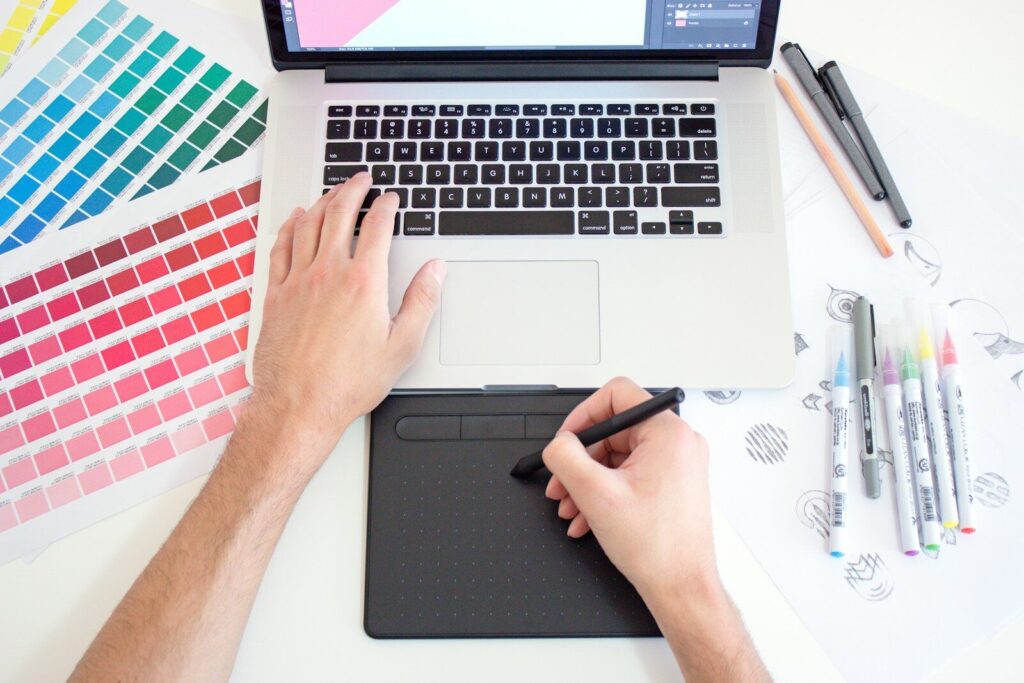
Photo by Theme Photos on Unsplash
Step 1: What Happens When We Review Your Uploaded Artwork?
Every great transfer starts with great artwork, and that review process begins the second your file lands in our system.
Our team checks:
- File format – ensuring your artwork is in a print-compatible format
- Resolution – flagging files too low-res to produce a sharp print
- Transparent backgrounds – confirming transparency is set correctly when needed, since DTF relies on precise white ink layering
- Print-ready status – looking for missing fonts, broken links, or embedded images that could derail production
- Sizing – verifying the artwork matches your intended final dimensions
This review catches problems before they become expensive mistakes. Our online ordering tools, including the DTF Gang Sheet Builder and upload-by-size options, are designed to make artwork submission straightforward even if you’re not a trained graphic designer.
If you’re preparing your own files, Adobe’s image resolution guide is a genuinely useful resource for understanding how resolution affects final print quality before you ever hit submit.
Step 2: Why Does Resolution Matter So Much for Fabric Printing?
Small resolution problems become big, visible problems once artwork is printed onto fabric. A logo that looks crisp on a phone screen can turn pixelated and jagged once it’s scaled up and pressed onto a t-shirt.
We check for:
- Low-resolution source files that won’t hold up at larger sizes
- Pixelation and jagged edges around fine details
- Proper scaling so artwork maintains sharpness at its final printed size
- Different needs for logos versus photographs, since photographic images often require different resolution handling than vector-style graphics
Investing a few extra minutes here prevents a far more expensive problem later: a finished transfer that looks great in the preview but blurry on the shirt.
Step 2.5: Why Does Color Management Separate Good DTF Transfers From Great Ones?
This is where most of the real craftsmanship in DTF transfer printing happens, and it’s also where high quality DTF transfers vary most dramatically between suppliers.
Why Do Colors Look Different On-Screen Than They Do Printed?
Your monitor displays color using RGB (red, green, blue light). Printers reproduce color using ink, typically CMYK (cyan, magenta, yellow, black) plus additional colors for expanded gamut printing. These are fundamentally different systems, which is exactly why a color that looks perfect on your screen can shift once it’s printed.
Printer profiles translate between these two color worlds. Without accurate profiling, ink limitations, and a properly expanded color gamut, you end up with washed-out gradients, inaccurate skin tones, and muddy blacks. Add in how white ink interacts with film characteristics and how heat pressing affects final color appearance, and you have a long chain of variables that all need to be controlled simultaneously.
The PRINTING United Alliance publishes widely respected best practices on color management and print production that illustrate just how technical this discipline really is. Adobe’s color management fundamentals guide is another strong resource if you want to understand how color profiles work before submitting artwork. For brands that need exact color matching across multiple print runs, Pantone’s color systems remain the industry standard reference point.
How Does Limitless Transfers Manage Color Accuracy?
We use an expanded CMYK+RGBO+White color gamut, combined with consistent equipment calibration and production profiling, to maintain color accuracy from file to finished transfer. This professional color management process produces:
- Vibrant, accurate color reproduction
- Smooth, bright gradients without banding
- Better skin tones in photographic artwork
- Cleaner, deeper blacks
- Smooth tonal transitions between colors
As we tell customers often:
“Professional DTF transfer printing isn’t just about buying an expensive DTF printing technology—it’s about controlling every variable in the production process.”
That means paying attention to ink quality, film quality, adhesive quality, printer maintenance, temperature, humidity, curing consistency, and operator experience, every single time, not just when conditions happen to be favorable.
Step 3: How Is Your Artwork Printed onto PET Film?
Direct to Film (DTF) printing starts with specialized DTF printers that print your full-color design onto PET (polyethylene terephthalate) film rather than directly onto fabric. Because the transfer will eventually be flipped and pressed face-down onto the garment, the printed design is mirrored, or inverted, during this stage.
The printing order matters here too. Full-color inks go down first, followed by a white ink layer that acts as a base, ensuring colors stay bright and opaque regardless of the fabric color underneath. This is what allows DTF transfers to produce bright colors and fine details on both light and dark garments.
Step 4: What Role Does Adhesive Powder Play in DTF Durability?
Once the design is printed on PET film, a fine thermoplastic adhesive powder is applied across the wet ink. This powder is what eventually bonds the transfer to fabric during pressing, so even application matters enormously.
After the powder is applied, excess powder is removed to keep the print clean and precise. This stage can generate dust, which is why proper ventilation and a clean production environment matter for both product quality and workplace safety. The OSHA guidelines on ventilation and airborne particulates are a useful reference for any facility handling adhesive powders at scale.
Adhesive quality directly affects wash durability down the line, so this isn’t a step that benefits from cutting corners.
Step 5: How Does Curing Affect the Final Transfer?
Curing uses controlled heat to melt the adhesive powder into a smooth, even layer across the printed design. According to DTF industry overviews, this curing process is what turns the printed ink and adhesive powder into a single flexible, durable layer capable of bonding permanently to fabric.
Proper curing temperature and consistency are critical. Poor curing can lead to:
- Cracking after just a few washes
- Peeling at the edges
- Weak adhesion to fabric
- Reduced overall durability
Professional curing equipment, combined with consistent process control, is what allows a transfer to go through a heat press and come out ready for long-term wear rather than falling apart after a handful of washes.
Step 6: What Quality Checks Happen Before a Transfer Ships?
Every transfer goes through inspection before it’s packed for shipping. We check for:
- Color accuracy against the original artwork
- Registration, ensuring layers align precisely
- Sharp detail retention
- Even ink coverage
- Film defects
- Adhesion quality
- Overall print consistency
Earning back-to-back 1st Place DTF Quality recognition in 2024 and 2025 requires multiple layers of inspection, not a single quick glance before an order goes out the door.
Step 7: How Are Orders Organized, Cut, and Prepared?
Many DTF orders are printed as gang sheets, meaning multiple designs are arranged on a single sheet for efficient layout and cost-effective printing. This approach works equally well for bulk orders and individual, personalized projects.
Limitless Transfers offers no minimums, meaning small businesses and individual creators can order exactly what they need. Our Gang Sheet Builder and upload-by-size options give you flexibility in how you organize your order, and every transfer arrives ready-to-press.
Step 8: How Fast Does Your Custom DTF Transfer Order Ship?
Finished transfers are packed in protective packaging and organized by order before shipping. Orders placed before noon EST ship the same day, and we offer free UPS Ground shipping on orders over $50.
For businesses working against customer deadlines, that turnaround time can be the difference between hitting a launch date and scrambling to explain a delay.

Why Does Professional DTF Transfer Printing Outperform DIY Setups?
Choose professional DTF transfer printing if consistent color accuracy, reliable durability, and production speed matter more to your business than the upfront cost of in-house equipment.
Professional Advantages
Professional production offers advantages that are difficult to replicate with a single in-house printer, including:
- Better color accuracy through calibrated profiles and expanded gamut printing
- Consistent print quality across large orders
- Routine print head maintenance that prevents clogs and downtime
- Access to higher-grade film, ink, and adhesive than many entry-level setups
- Production expertise built from handling consumable materials and equipment maintenance daily
DIY DTF printing is possible, but print head clogs, inconsistent curing, and the learning curve around color profiling often lead to wasted materials and inconsistent results, especially for businesses that need to scale.
Why Do Businesses Choose DTF Transfer Printing Over Other Methods?
DTF transfer printing has grown popular for apparel decoration because it offers:
- Lower setup costs than traditional screen printing
- Strong suitability for small orders and personalized apparel
- Compatibility with bulk production runs
- Fast turnaround times
- No fabric pre-treatment requirement
- Ready-to-press convenience
- Professional, durable results
How Does DTF Compare to Screen Printing, DTG, Sublimation, and HTV?
Choose screen printing if you need very large bulk orders of a single design and setup costs can be spread across high volume. Choose DTG (direct-to-garment) if you’re printing photorealistic designs directly onto finished cotton garments in small quantities. Choose sublimation if you’re working with 100% polyester and want the design permanently dyed into the fabric itself rather than sitting on top of it. Choose heat transfer vinyl (HTV) if you need simple, bold single-color designs and have the time to weed vinyl by hand.
Choose DTF transfer printing if you want full-color, photorealistic designs with no minimums, compatibility across nearly any fabric type, and the flexibility to fulfill small custom orders and bulk production from the same process.
What Fabrics Work Best with DTF Transfers?
One of the biggest advantages of DTF transfer printing is fabric versatility. DTF transfers work well on:
- Cotton
- Polyester
- Cotton/poly blends
- Tri-blends
- Nylon
- Canvas
- Denim
- Leather
- Spandex
- Wood (for decorative, non-apparel applications)
Because DTF doesn’t require fabric pre-treatment, it works on both light and dark garments. The white ink layer provides excellent opacity, so colors stay vibrant even on darker fabric backgrounds. This broad compatibility is part of why DTF has become a go-to method for businesses that print across multiple garment types rather than specializing in just one.
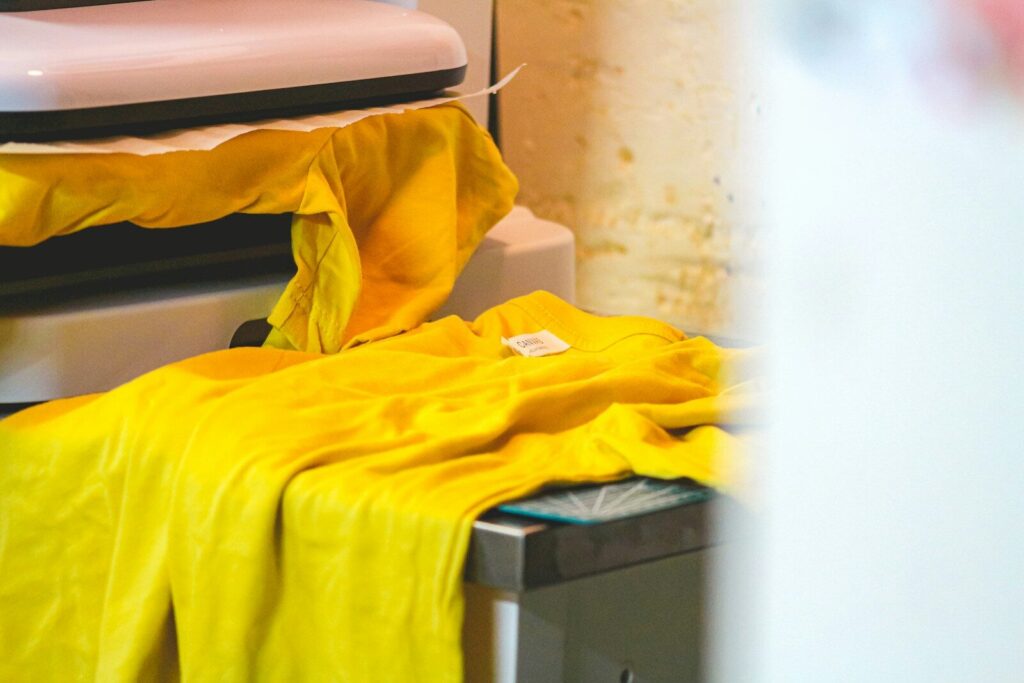
Photo by Compagnons on Unsplash
How Do You Apply DTF Transfers for the Best Results?
Getting a clean, durable press comes down to following the right sequence:
- Preheat the garment for a few seconds to remove moisture and wrinkles.
- Position the transfer exactly where you want the final design.
- Press at approximately 300–320°F (commonly around 310°F) for 10–15 seconds using medium to firm pressure. Always follow your specific transfer supplier’s recommended settings, since film and adhesive formulations vary.
- Peel while warm if you’re using a hot/warm-peel film.
- Repress for approximately 5 seconds, using parchment paper if recommended for your transfer.
- Allow the garment to cool fully before handling or folding.
A standard heat press delivers the most consistent results, though a Cricut EasyPress can work for smaller individual projects. A household iron is possible for some transfers but is generally less consistent than a heat press due to uneven pressure and temperature control.
How Should You Care for Finished DTF Apparel?
Proper aftercare extends the life of any DTF transfer significantly. We recommend:
- Washing garments inside out
- Using cold water
- Choosing a mild detergent
- Avoiding bleach
- Tumble drying on low heat
- Avoiding excessive heat exposure during drying or ironing
Properly produced and properly applied DTF transfers can withstand 100+ washes while maintaining vibrant colors and resisting cracking or peeling. For deeper guidance on fabric care that protects printed garments over time, Cotton Incorporated offers useful fabric care recommendations, and AATCC maintains established textile testing standards covering wash durability and colorfastness that the broader industry relies on.
Why Does Limitless Transfers Take Every Step This Seriously?
Every stage of this process, from artwork review through color management, printing, powder application, curing, quality control, and shipping, exists to deliver one outcome: a transfer that performs exactly as expected when it reaches a heat press.
That attention to detail is how we’ve earned back-to-back 1st Place DTF Quality recognition in 2024 and 2025, and it’s reflected in the vibrant colors, soft-hand feel, and reliable durability customers count on order after order. Combined with same-day shipping for orders before noon EST, free UPS Ground shipping over $50, and an easy ordering process through our Gang Sheet Builder, we aim to be more than a supplier. We aim to be a production partner that helps businesses and creators grow with confidence in every order.
Ready to see the process for yourself? Upload your artwork and experience what professional DTF transfer printing looks like from start to finish.
Frequently Asked Questions
How can I print my own DTF transfers?
Printing your own DTF transfers at home requires a DTF printer, DTF-specific inks, PET film, adhesive powder, and a curing method such as a curing oven or heat press. Success depends heavily on color profiling, consistent powder application, and precise curing temperatures, which is why many businesses choose a professional supplier instead of managing all these variables in-house.
How much does DTF printing cost?
DTF transfer pricing varies based on order size, design complexity, and gang sheet layout. Rather than relying on a general estimate, the most accurate way to see current pricing is to explore gang sheet options directly through our Gang Sheet Builder, which shows real-time pricing based on your specific order.
Can I print DTF transfers on a regular printer?
No. DTF transfer printing requires a specialized DTF printer capable of handling white ink and printing onto PET film, along with a separate adhesive powder application and curing process. Standard home or office printers aren’t built for this workflow and can’t produce a wearable, durable transfer.
Which one is better, DIRECT To Film or sublimation?
Choose DTF if you need to print on a wide range of fabrics, including cotton, blends, and dark-colored garments, since DTF transfers sit on top of the fabric with a white ink base. Choose sublimation if you’re working exclusively with 100% polyester or polymer-coated items, since sublimation dyes bond directly into the fabric fibers for a design with no texture at all.
The Complete Journey from Upload to Doorstep
From the moment your artwork is uploaded, it passes through artwork review, resolution checks, careful color management, PET film printing with white ink, adhesive powder application, controlled curing, multi-point quality control, organized cutting, and fast, protected shipping. Every single step contributes to the vibrant, durable and premium DTF transfers you receive.
That’s the difference between a transfer that merely looks good in a photo and one that holds up through a hundred washes. Upload your artwork today and see what professional DTF transfer printing can do for your next project.